
At least 11 people, including two army jawans, were killed while over 100 others were evacuated to safety as the unprecedented snowfall in March triggered avalanches and damaged over 150 structures including dozens of houses in Jammu and Kashmir.

'Does the Indian army's new assertiveness risk a clash escalating into shooting and possibly skirmishes?' asks Ajai Shukla.

Chinese People's Liberation Army recently made a two-pronged simultaneous incursion by sending its troops into Indian waters in the Pangong lake as well as five km deep into Indian territory through the land route in the same area, according to reports.

Xi will attend the second informal meeting with Modi at Mahabalipuram near Chennai from October 11 to 12 and pay a state visit to Nepal on October 13, Foreign Ministry spokesperson Hua Chunying announced on Wednesday.

"The army chief chief reviewed the security situation in Jammu and Kashmir and also operational preparedness of Northern Command at a high-level meeting," officials said.

'As for tricky relations with China, India needs less of summitry type event management and more anticipatory analysis and management of events,' says Ambassador Jaimini Bhagwati.
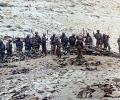
In fact, given the current tensions and massed troops on both sides, there is a danger that the LAC will become more like the Line of Control with Pakistan, a heavily fortified and strongly defended border where weapon fire exchanges regularly occur. Indeed, Stratfor Worldview research has listed a sharp increase in new Chinese facilities along the LAC in 2019-20.

Arpi deserves to be complimented for the commitment and hard work that have gone into this production. The frustrations of seeking reliable documentation from the catacombs of the Indian bureaucracy did not deter him from going after the best information available, and the result is one that he can take much satisfaction in. Ambassador Prabhat P Shukla, Member Advisory Council, Vivekananda International Foundation, reviews Claude Arpi's The End of an Era: India Exits Tibet.

In the fourth such incursion since March, two helicopters of the People's Liberation Army of China hovered for about five minutes in Uttarakhand's Chamoli district and "could have carried out aerial photography of Indian ground troops," according to official sources in the government.

A bright sunny day and rise in night temperature brought some respite from cold in most parts of the northern India except Kashmir valley where the mercury dipped further.

Solo female traveller Swati Jain, who quit her job to travel, speaks of her adventures, challenges, learnings and what keeps her going.

The Chinese have just one commander for all the forces confronting India. Commanders of all these forces answer to one man, and one headquarter. India, on the other hand, offers a diversity of options that is a military embarrassment in the 21st century. In Arunachal and Sikkim-Bhutan, the Eastern Army Commander is in charge. In the Uttarakhand (central) sector, it will be the Central Army Commander. The Himachal-Tibet border is the domain of the Western Army Commander. And all of Kashmir and Ladakh further on, the Northern Army's. Effectively, an array of at least eight 'three-star' commanders will be arrayed against one Chinese, says Shekhar Gupta.
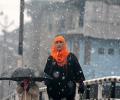
After landslide victories in the Lok Sabha and assembly elections, the BJP is hoping to crest the tide in Jammu and Kashmir, confident of both Hindu and Muslim votes

Mercury continued its free fall in Kashmir division as Leh in Ladakh region recorded the coldest night this winter with a minimum temperature of minus 16.3 degrees Celsius.

'The Chinese navy is large and expanding both in numbers and capability by the day.' 'India too must take measures to safeguard its own interests, now and in the future.'

China on Sunday said the border dispute with India has been "contained" and the Indian elephant and Chinese dragon should "do more" to strengthen the bilateral cooperation to facilitate its settlement.

The cold conditions returned in Kashmir division as the night temperature in most places, including Leh, plunged further below the freezing point followed with clear skies and unusual sunny days.

There was some respite in cold conditions in Kashmir as the mercury went up by several degrees at most places after four days of virtual free fall.

Chinese Vice Foreign Minister Liu Zhenmin "called in" India's envoy in Beijing Ashok Kantha to lodge a protest on Modi's visit on Friday

BJP's Member of Parliament Tarun Vijay on why he chose to demand national status for Tamil
The new 17 Strike Corps with 80,000 troops and a budget of Rs 64,000 crore will provided the much-needed offensive capacity against China. R S Chauhan reports.

'The need of the hour is to build on the positives and control the negatives,' says Colonel (Dr) Anil A Athale (retd).
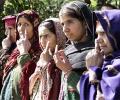
Bikash Mohapatra presents a kaleidoscope of views from Jammu and Kashmir, where the five-phase polling for its six seats ended last week.

'The intrusion in Chumar, during and beyond the Chinese president's visit, is unprecedented and has qualitatively changed the tone of the India-China relationship,' says Jayadeva Ranade, a member of the National Security Advisory Board.

'Clearly, there is a wide gap between the stated intentions of China's top leadership to improve relations with India and the PLA's aggressive border management,' says Brigadier Gurmeet Kanwal (retd).

China is spending billions of dollars to improve infrastructure in Tibet and other parts of its border with India. Claude Arpi explains why New Delhi can't afford to ignore Beijing's plans.

It also dismissed Jaitley's remarks that India of 2017 is different from what it was in 1962, saying China too is different.
India brought in more troops after the destruction of two of its bunkers and "aggressive tactics" adopted by the Chinese People's Liberation Army

Harish Kapadia is the only Indian to win mountaineering's most prestigious award.

Indians want change and progress. They should be willing to accept tough decisions, says Sanjeev Nayyar.
Kashmir Valley on Thursday experienced fresh snowfall with most places, especially the plains, witnessing the first snow of the season, breaking the prolonged dry spell at the fag end of 'Chillai-Kalan', the 40-day period of harshest winter. While the snowfall was mild and brief, it nonetheless brought much joy to the locals.

'Chinese leaders rarely receive their foreign guests in cities other than Beijing. Such respect for India!' 'Does it mean that Modi could replicate "the warmth and unconventional way" by sending Indian troops into Tibet, as Xi did in Chumur (Ladakh) when he arrived in India? Of course, Indians are far too polite to do so,' says Claude Arpi.

'The military aim in a future conflict, if it can't be avoided, should be to cause maximum damage to the adversary's war waging capability and capture limited amount of territory as a bargaining counter,' says Brigadier Gurmeet Kanwal (retd).

Two young cyclists have embarked on a cycling tour across India with an aim to support girl child education.

Prime Minister Narendra Modi's visit to Arunachal Pradesh on Friday, February 20, irritated the Chinese government so much that it summoned the Indian ambassador to register its protest against Modi visiting a territory China claims as Southern Tibet.
'It is certainly time for New Delhi to open up. Not only should it go ahead at full steam with the roads to the LAC, but the government must also allow tourists to visit these stunningly beautiful areas of Indian territory.'


Conde Nast Traveller sorted through the wish lists of wildlife enthusiasts from around the world to collate this definitive guide. How many will you cross off?

'There are major implications for India. Though there was a transparently thin attempt to project the troop reduction as intended to promote peace, the downsizing is actually part of plans to streamline and strengthen the PLA, capable of defending China's national interests at home and abroad,' says Jayadev Ranade.
In all the noise surrounding the Dok La confrontation, Claude Arpi focuses on a crucial issue that has hardly been covered -- the construction of roads for the armed forces and the local population to reach the most remote border posts.
